Before choosing individual flowers, choose the bouquet silhouette. Two bouquets can use nearly identical roses and greenery but look completely different depending on whether their stems make a neat dome or flow outward.
Here are the main design differences and the questions to ask before settling on a shape. Styles overlap in real floristry, and your florist may use different terminology.
Round or dome bouquet: balanced and classic
A round bouquet places its visual mass in a circle, usually with short transitions between flower heights. It suits garden roses, ranunculus and small supportive blooms. It can be tightly arranged or somewhat relaxed, but the outline stays recognizable.
Best for someone who likes a timeless silhouette in photographs. If your bouquet looks too stiff, ask for subtle variation in petal texture rather than adding long protruding stems.
Loose garden-style bouquet: natural movement
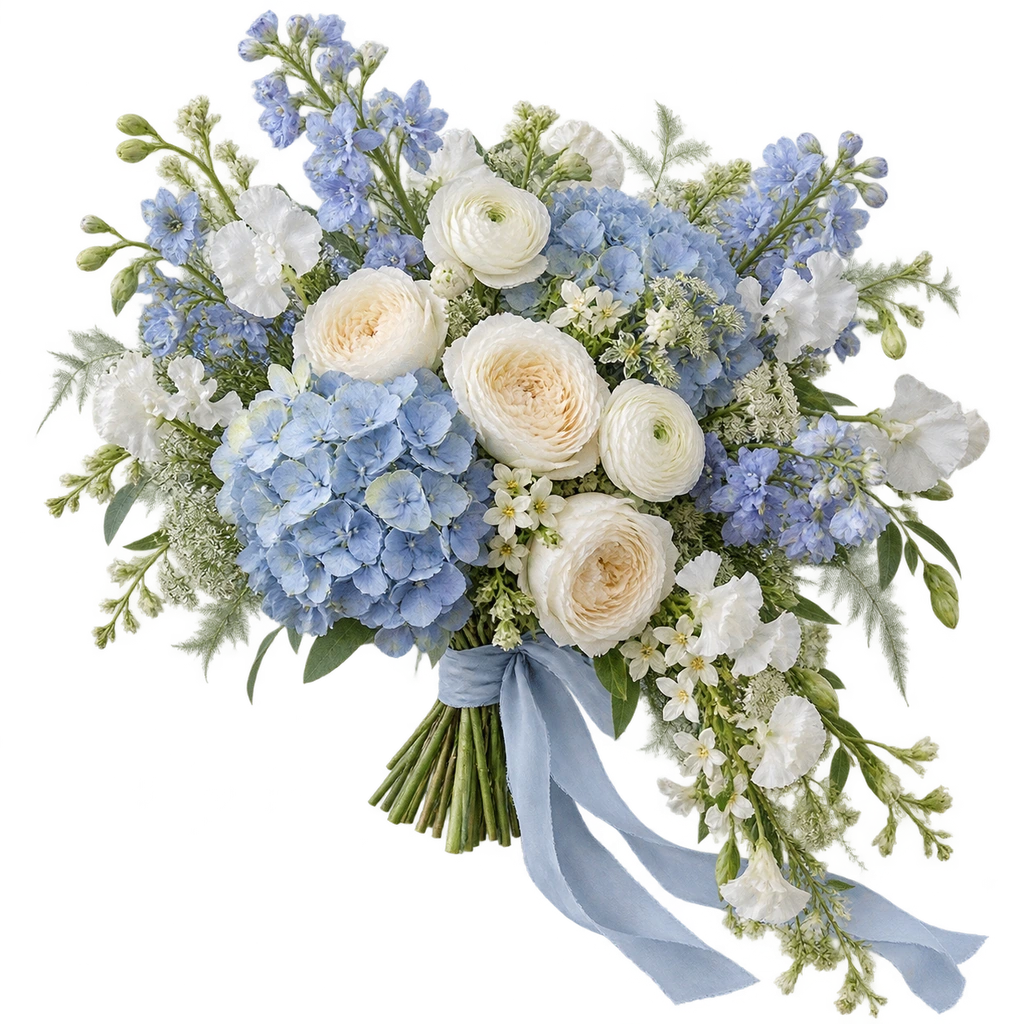
A garden-style bouquet uses varied stem heights, airy gaps, irregular edges and carefully placed flower clusters. It is intentionally composed even when it appears effortless. Sweet pea, lisianthus, foliage and different rose forms can add movement.
A common mistake is making every ingredient stick out the same amount. Keep a clear focal area and a few deliberate extensions. You can explore this feel in PetalMeld using the Wildflower starting idea.
Cascading bouquet: a directional silhouette
A cascade has a full floral center and a visible downward line created by flowers, foliage or vines. It needs careful balance, mechanics and attention to how it is held. The drop should look purposeful rather than like stray stems hanging out.
If you love a waterfall shape, consider the length relative to the outfit and the visual weight of the flowers. A very long cascade can obscure dress detail in close portraits.
Asymmetrical or crescent bouquet: one intentional sweep
Instead of equal volume on every side, an asymmetrical design extends further in one direction. This can look contemporary or garden-inspired, depending on the blooms.
Ask which side of the bouquet is the front in photographs, and whether your florist will design a particular holding orientation.
Which style should you start with?
Choose the round shape if you want simple, centered, classic. Choose garden if you love air, movement and varied textures. Choose a cascade if you want drama and a trailing profile. If undecided, begin with a small round bouquet and experiment with a few off-center pieces.
Use the design walkthrough to build your first version and the stem-count guide to discuss realistic fullness.
Plan it in PetalMeld: Choose a design, customize the flower mix for free, and export the free Florist Brief. Flower counts, colors and visual previews are planning aids; your florist confirms real materials and pricing.
Explore bouquet ideas →