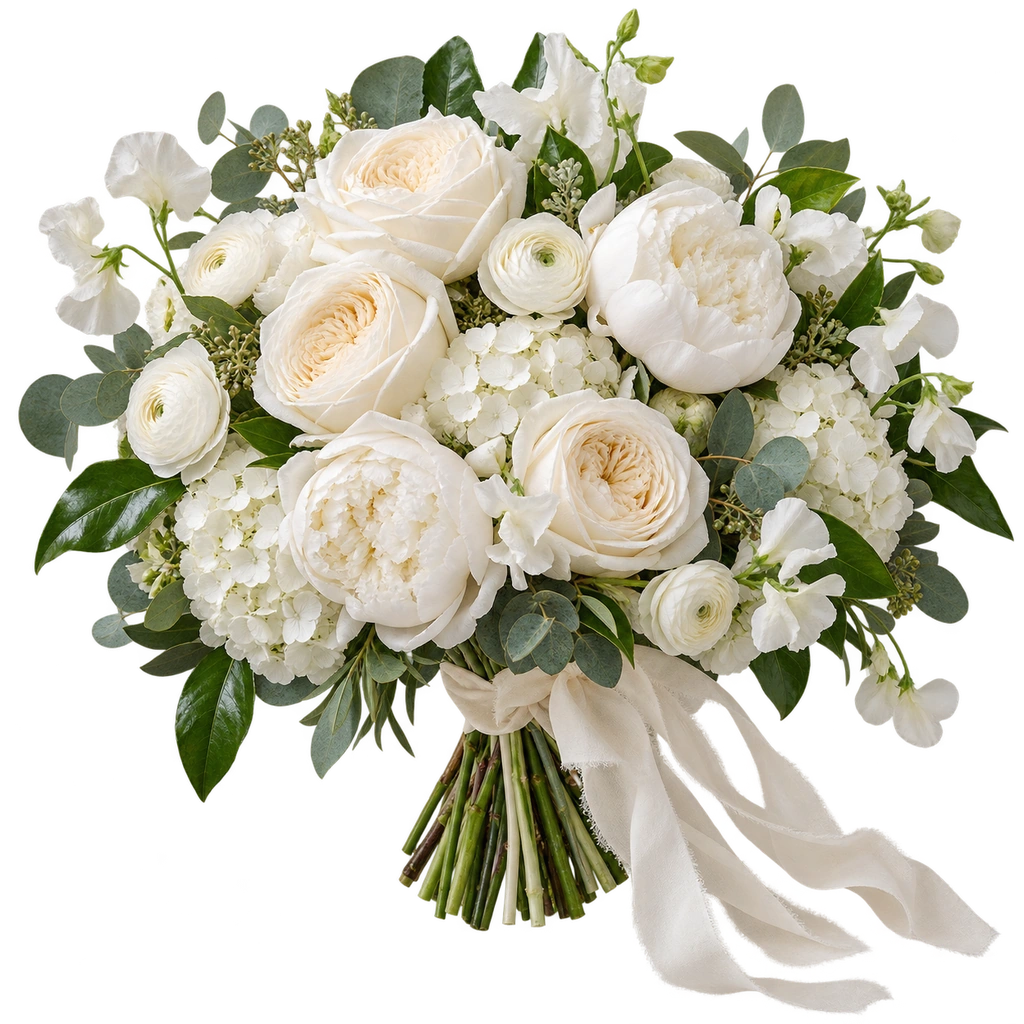
The best bouquet ingredient list is not necessarily the longest one. A handful of related varieties can look intentional when each has a job: providing a focal point, bridging gaps, adding movement or outlining the silhouette.
A flower you love in a close-up photograph may behave differently in an actual hand-tied bouquet. Consider size, durability, color availability and how the stem reads from across a room.
Focal flowers: establish the main shape
Garden roses give a layered, romantic center; peonies are lush and dramatic when available; dahlias range from sculptural to soft; hydrangeas create volume with clusters of small florets. These flowers are visually prominent, so pick one or two to lead.
Keep the final dimensions in mind. Several oversized blooms may consume the entire bouquet footprint before you add any texture.
Supporting flowers: make transitions graceful
Ranunculus can bridge between big focal roses and smaller accents. Lisianthus often carries buds and multiple blooms, adding softness and a more natural rhythm. Spray roses can create small color echoes around larger flowers.
A support flower does not have to match the focal flower exactly. Similar undertones or complementary petal textures can make the design feel cohesive without appearing flat.
Accents and texture: use restraint
Sweet pea can add movement, laceflower softens edges, and anemones can create striking centers. Tall stems such as delphinium may work better in an asymmetrical or cascading composition than in a tight dome.
Try removing the last filler you added: if the bouquet becomes clearer, the filler was probably doing too much.
Greenery: an outline, not an afterthought
Silver-dollar eucalyptus can provide rounded leaves; seeded eucalyptus adds texture; olive branches create a leaner, natural feel; finer ferns lighten dense blooms. Their availability and exact appearance vary by supplier.
Greenery can be a visual ingredient or a construction ingredient. The number of stems in a digital composition should not be treated as a direct instruction to your florist.
Seasonal substitutions you can discuss
If your preferred peony is difficult to source, a garden rose may achieve a similar layered, romantic effect, though it is not identical. If a specific dahlia color cannot be supplied, ask about comparable garden roses, chrysanthemums or other locally obtainable blooms.
Show your florist which feature matters most: the pale blush color, the rounded shape, the high petal count or the flowing silhouette. Our month-by-month guide gives planning starting points, not guaranteed availability.
Try a limited recipe before expanding
Choose two main flower varieties, one support flower and one greenery type. Build the bouquet, then decide whether a fifth ingredient genuinely improves it. The Timeless White preset is a helpful starting point to customize instead of choosing every flower from scratch.
Plan it in PetalMeld: Choose a design, customize the flower mix for free, and export the free Florist Brief. Flower counts, colors and visual previews are planning aids; your florist confirms real materials and pricing.
Explore bouquet ideas →